About Me
I’m a
- computer science graduate from Georgia Tech—completed my degree in December 2025
- web developer, focused on frontend frameworks but happy to work full-stack
- technical writer who loves making complex ideas accessible and perfecting specifications for AI tools
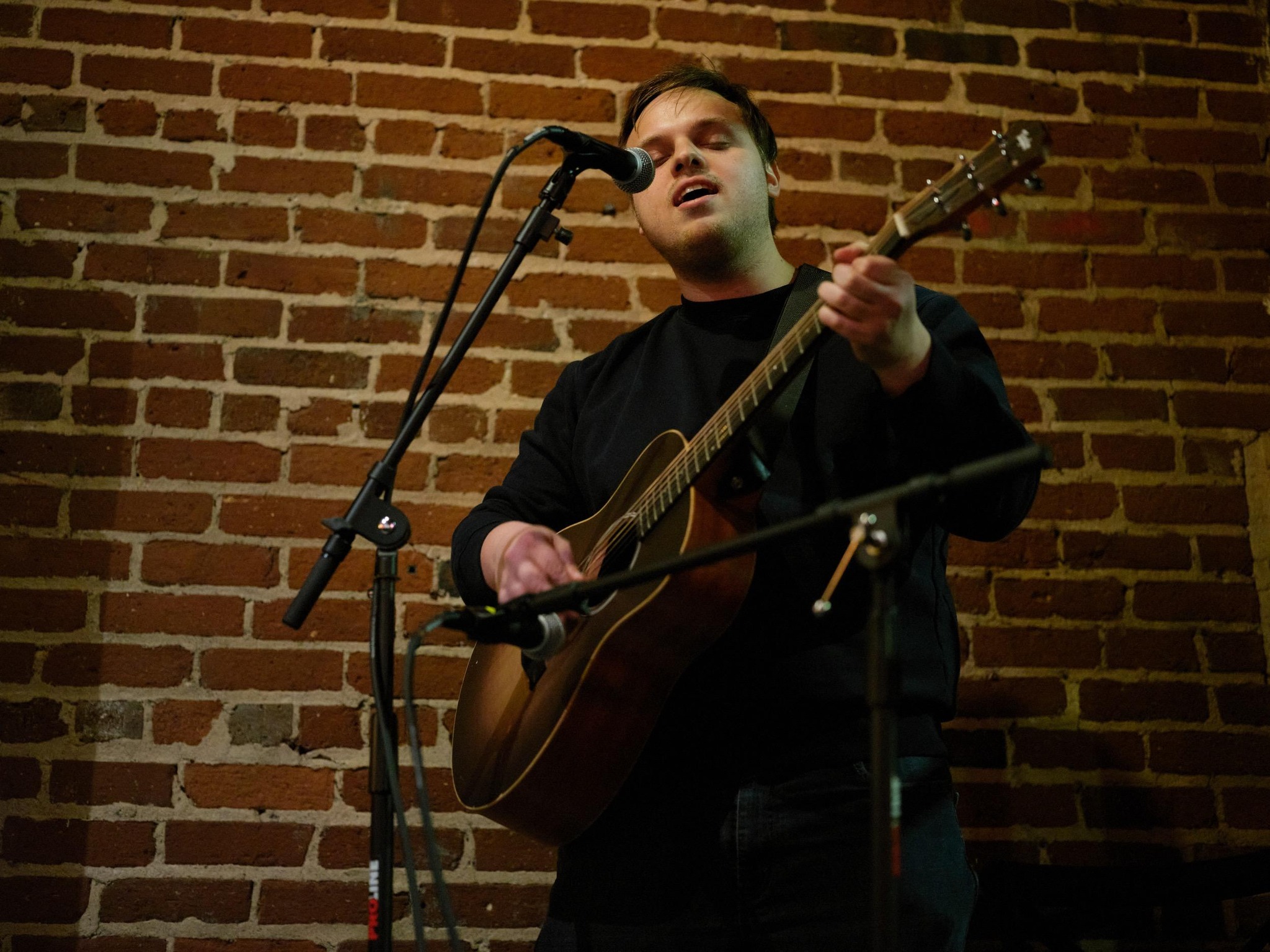
- singer-songwriter performing at open mics around Atlanta
My concentrations at Tech were People (which is UX/HCI) and Theory (which is math). As an undergraduate researcher, I worked in digital humanities, a field that believes that technology and liberal arts should inform each other. In my time away from school, I focused on documentation and dev education.
I’m looking for roles in software development, technical writing, or developer experience. If you’re interested in connecting, please reach out!
Resume
My work experience is listed on my Resume.
Projects
Songshed
Songshed is a grid-based guitar tab editor written in Vue. Unlike other tab editors, it allows you to specify exactly where a note is positioned in time without having to use traditional staff notation. The app is still a work in progress, but it stands as a proof-of-concept for a new user interface for music composition.
The UI is completely responsive—as you change the screen size, the tab horizontally fills the screen. If the screen gets too small, it automatically breaks off bars into new lines.
Bends, ties, and slides are SVGs that connect one note or column to another, and I wrote a manual rendering system with Vue directives that allow the SVGs to coordinate with the responsive CSS of the tab. If an SVG connects two notes that are then broken into two lines, it will split, showing part of it on the first line and part on the other.
The editor also has a selection system, allowing you to copy, paste, and delete groups of notes and to move them by dragging. It has an annotation system that lets you drag to create a text annotation that spans between positions.
Neurostream
Starting in January 2024, I joined the Wellbeing and Mental Health project at Georgia Tech. The goal of this research team was to use the observe neurophysical markers of mental wellness. We used the Muse EEG headset to record EEG and heart rate data while participants took a wellness survey.
I built a web-based React app that uses the muse-js library to visualize EEG and PPG data and record them to a CSV. I also wrote a script for Qualtrics that kept track of how the user interacted with the survey, so that we could see what the EEG data looks like when, for example, the user was answering a question about loneliness.
The Future of the Talmud
In 2019 and 2020, I ran the first funded undergraduate-led project in the Digital Integrative Liberal Arts Center at Georgia Tech. Our goal was to emulate the visual form of the Talmud using HTML and CSS, and then expand on that by building interactive tools for Talmud study. We published an open source library and presented a demo app at the lab’s showcase.
Our team partnered with Sefaria and later built a Talmud word translation machine learning project. Last year, our work was featured in their 10 year recap video.
Talks and Videos
Simplifying Reactivity with SolidJS - React Brussels
I gave this talk in person at React Brussels in 2022. In it, I explain SolidJS’s fine-grained reactivity from first principles and contrast it to React.
Vite for Education - ViteConf
This was a prerecorded talk at ViteConf 2022. I demoed an interactive tutorial builder built on top of StackBlitz’s WebContainers.
Breaking Down the Web - Interview Series
I interviewed experts in the world of frontend web development with the goal of breaking down what they’re working on.
Introduction to Reactivity with SolidJS
This video lived on the SolidJS homepage for a year. Similar to my React Brussels talk, it builds the concepts behind Solid from the ground up and demos it using its REPL.
Contact
The best way to contact me is by email at danjutan@gmail.com.
If you’re interested in connecting with me personally, feel free to reach out on Instagram.